



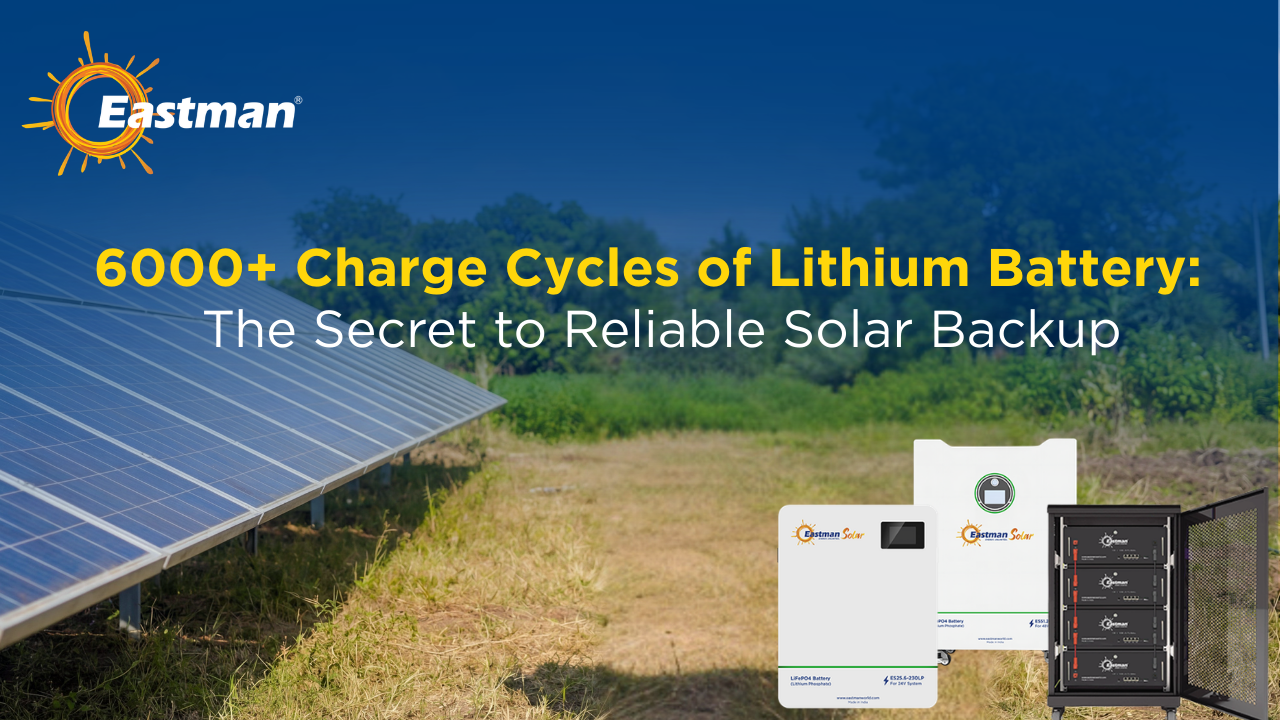
6000+ Charge Cycles of Lithium Battery: The Secret to Reliable Solar Backup
As solar adoption accelerates across India, energy storage is becoming just as important as solar power generation. While solar panels generate electricity during daylight hours, a solar energy storage system ensures power is available at night, during peak hours, or during unexpected grid failures.
For Indian homeowners, commercial establishments, and industrial users, choosing the right battery is critical. Among all technical specifications, one number has emerged as a true indicator of durability and long-term value: a 6000+ charge cycle lithium battery.
But what does this mean? And why is it important for anyone investing in rooftop solar in India? Let’s dive in.
What does 6000 Charge Cycles mean in a Lithium Battery?
A charge cycle refers to one complete discharge and recharge of a battery. For example:
Using 100% of battery capacity and recharging it = 1 cycle
Using 50% today and 50% tomorrow before recharging = 1 full cycle
If a battery is rated at 6000 charge cycles, it means it can be charged and discharged 6000 times before its capacity reduces to around 80% of its original level.
This directly defines the lithium battery cycle life. For Indian solar users who rely on daily cycling, this number determines how many years the battery will last.
Lithium Battery Cycle life vs Lead-Acid Battery: A Comparison
When comparing lithium and lead-acid batteries, the biggest difference lies in cycle life.
Battery Type | Typical Cycle Life | Expected Lifespan (1 Cycle/Day) |
Lead-Acid | 800–1500 cycles | 3–5 years |
Standard Lithium | 2000–3000 cycles | 6–8 years |
LiFePO4 Battery (6000 Cycles) | 6000+ cycles | 15–16 years |
Under Indian conditions, where batteries may cycle daily due to power cuts or hybrid solar usage, this difference becomes financially significant. A long-life solar battery reduces replacement frequency and lowers long-term ownership costs.
Lithium Battery Lifespan in India: Why Climate Matters
India’s climate presents unique challenges:
High summer temperatures (45°C+)
Voltage fluctuations
Frequent power outages
Dust and humidity in many regions
Traditional batteries degrade quickly under heat stress.
However, LiFePO4 battery technology (6000 cycles) offers:
High thermal stability
Better chemical safety
Reduced degradation
Stable long-term performance
This makes high-cycle lithium battery solutions far better suited to Indian operating conditions.
How 6000 Cycles are 15+ Years of Solar Backup
Let’s calculate how these 6000 cycles become 15+ years:
1 cycle per day
365 cycles per year
6000 ÷ 365 = approximately 16 years
That means a properly designed solar lithium battery for homes in India can last nearly as long as your inverter warranty period. This aligns perfectly with rooftop solar investment timelines.
Depth of Discharge & Its Impact on Lithium Battery Cycle Life
Another critical factor is Depth of Discharge (DoD). Lithium batteries typically allow 80%–90% DoD safely. Lead-acid batteries typically allow only around 50% DoD
This means lithium batteries provide:
More usable energy daily
Less strain per cycle
Better overall lithium battery lifespan in India
When evaluating the best lithium battery for solar in India, always check both cycle life and DoD rating.
How 6000 Charge Cycles Improve Solar System ROI
Many solar buyers calculate:
Solar panel cost
Inverter price
Installation charges
But often ignore the solar battery replacement cost in India.
If a battery needs replacement every 4–5 years, you may spend ₹1,00,000–₹2,00,000 over 15 years. A 6000+ charge cycle lithium battery significantly reduces:
Replacement frequency
Maintenance costs
Downtime
Performance instability
This directly improves long-term solar ROI.
Role of BMS in achieving 6000 Cycles
High cycle life is not just about chemistry. Modern lithium batteries use an advanced Battery Management System (BMS) that:
Prevents overcharging
Prevents deep discharge
Balances cells automatically
Monitors temperature
Protects against short circuits
This intelligent monitoring ensures the battery consistently delivers its rated cycle life.
Ideal applications of High-Cycle Lithium Battery in India
A solar battery with 6000+ cycles is ideal for:
1. Residential Hybrid Solar Systems- Daily cycling for evening loads and backup power.
2. Commercial Establishments- Offices, retail stores, and clinics that require an uninterrupted power supply.
3. Industrial Applications- Factories needing reliable backup in grid-unstable areas.
4. Telecom & Remote Installations- Long service life reduces maintenance visits and operational costs.
How High-Cycle Lithium Battery is the future of Solar System Storage in India
India’s renewable energy targets and rising electricity tariffs are pushing consumers toward smarter energy storage decisions. Future-ready solar buyers are prioritizing:
Longer lithium battery lifespan
Higher cycle durability
Better safety standards
Reduced maintenance
Long-term financial predictability
A 6000+ charge cycle lithium battery is no longer a premium feature; it is becoming the benchmark for reliable solar storage.
Eastman LiFePO4 Lithium Batteries: Designed for Long-Term Energy Storage
Eastman offers advanced LiFePO4 battery solutions engineered for 6000-cycle performance in Indian solar applications. Eastman batteries are built with:
6000+ charge cycles (under rated conditions)
Advanced LiFePO4 chemistry
Integrated Battery Management System (BMS)
Rack, wall, and floor-mount configurations
Thermal and electrical protection systems
Compatibility with hybrid inverter battery systems
These features make Eastman a strong contender when evaluating the best lithium battery for solar in India.
Conclusion
When selecting a solar lithium battery for homes in India, cycle life is one of the most critical parameters. A 6000+ cycle battery offers:
15+ years of dependable service
Lower solar battery replacement costs
Higher ROI
Better sustainability
Improved energy independence
For Indian homeowners, businesses, and industrial users investing in rooftop solar, choosing a high-cycle lithium battery ensures that your energy storage system remains reliable for years to come.
With advanced LiFePO4 chemistry and intelligent battery management, Eastman continues to strengthen its position in long-term solar energy storage solutions.
Contact Eastman Solar for more information.
Explore the Solar Lithium Batteries for more information.
Use your nearest Store Locator for convenience.
FAQ’s
Q1. What does 6000 charge cycles mean in a lithium battery?
It means the battery can be charged and discharged approximately 6,000 times before its capacity drops to about 80% of its original value.
Q2. How many years will a 6000-cycle battery last?
If used once daily, it can last approximately 15–16 years.
Q3. Are lithium batteries better than lead-acid batteries for solar storage?
Yes. Lithium batteries offer longer cycle life, higher depth of discharge, lower maintenance, and better efficiency.
Q4. Does higher cycle life improve ROI?
Yes. It reduces replacement costs and ensures consistent performance over long durations.
Q5. Are Eastman lithium batteries suitable for Indian conditions?
Yes. They are engineered with LiFePO4 chemistry, an integrated BMS, and protection features designed for reliable operation in Indian climatic conditions.

 78728 78728