



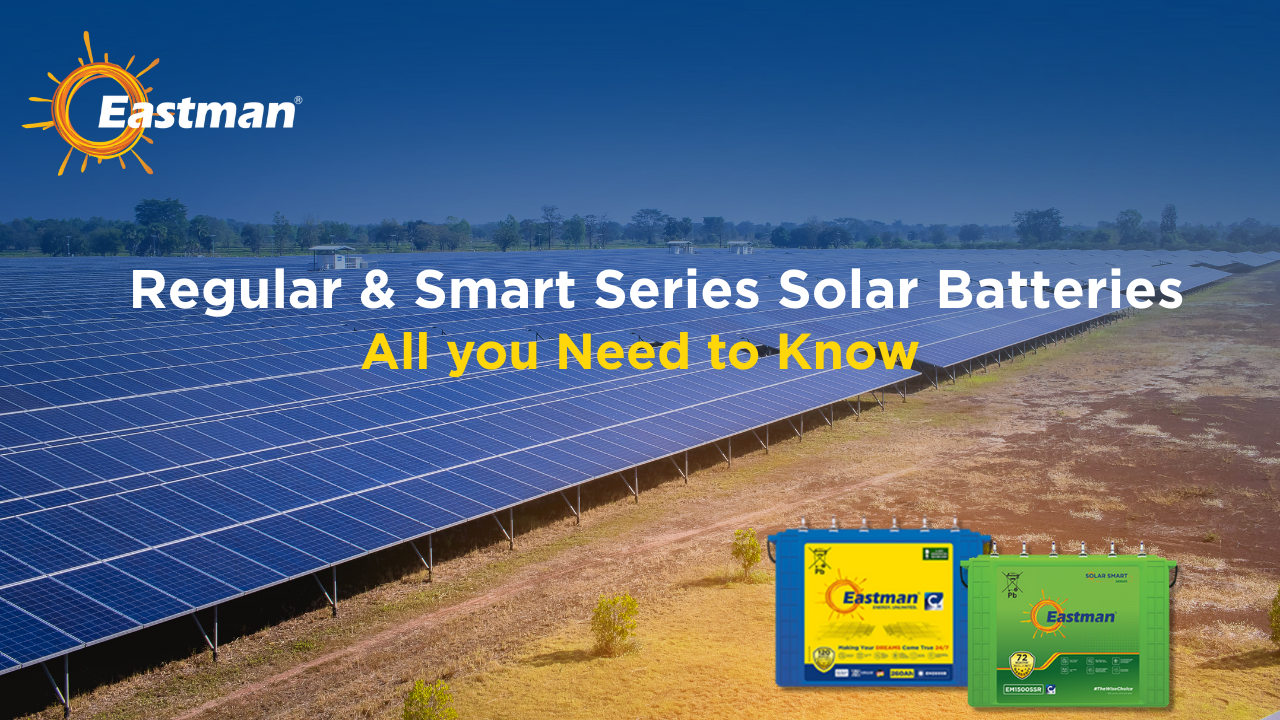
Regular & Smart Series Solar Batteries: All You Need to Know
As solar energy adoption continues to grow across residential and commercial sectors, energy storage has become a critical component of modern power systems. While solar panels generate electricity during daylight hours, energy demand often extends beyond this period. Solar batteries bridge this gap by storing excess energy and making it available when generation is low or unavailable.
With increasing focus on reliability, efficiency, and long-term value, users are seeking battery solutions that can support both present needs and future expansion. This guide explores Regular and Smart Series solar batteries, explaining how they work, their benefits, ideal applications, and key considerations for selecting the right system.
Why solar batteries matter & how it works
Solar generation is inherently variable. Without energy storage, excess electricity produced during the day may be underutilized or exported to the grid with limited benefit. Solar batteries allow users to store this energy for later use, improving overall system effectiveness and reliability.
Solar batteries help to:
Store excess solar energy
Provide power during nighttime hours
Support operation during grid outages
Reduce dependence on utility power
Improve energy self-consumption
As energy systems become more decentralized, battery storage is no longer optional, it is essential.
How Solar Batteries Work in a Solar System:
Solar battery systems are designed to ensure that energy generated during peak sunlight hours remains available when it is most needed. These batteries function as an integral part of the solar power ecosystem, working in coordination with solar panels and inverters to store and supply energy efficiently.
Stored energy is used during:
Night-time hours
Cloudy or low-generation periods
Grid outages
Peak electricity tariff windows
Typical Operating Cycle
Solar panels generate DC electricity during daylight hours
Excess DC energy is stored in solar batteries
The inverter converts DC power into AC power for household or commercial loads
Stored energy is supplied automatically when solar generation is insufficient
In Smart Series systems, real-time monitoring and intelligent control further enhance efficiency through adaptive charging and strategic discharge management.
Understanding solar battery categories
Modern solar battery solutions are designed to serve different energy requirements and system complexities. Broadly, they can be categorized into two types:
Regular Series Solar Batteries
Designed for reliable, straightforward energy storage with a focus on consistency, durability, and ease of operation.
Smart Series Solar Batteries
Advanced storage solutions equipped with intelligent management features that enhance efficiency, monitoring, and energy optimization.
Both categories are suitable for residential and commercial solar installations, differing primarily in the level of control and system intelligence they offer.
Core characteristics of high-quality solar batteries
Regardless of category, effective solar batteries share several essential characteristics:
Stable and efficient cell chemistry
Effective thermal management for varied climates
Low self-discharge to preserve stored energy
Scalable design for future expansion
Warranty-backed assurance for long-term reliability
These features ensure dependable performance, reduced maintenance requirements, and consistent energy availability over time.
Regular series solar batteries explained
Regular Series batteries are ideal for users seeking dependable energy storage without complex monitoring or advanced automation.
Key Features
Compatibility with commonly used inverter systems
Durable construction supporting consistent charge–discharge cycles
Stable performance for everyday solar applications
Cost-effective entry into solar energy storage
Suitable for residential and small commercial installations
Ideal Applications
Homes aiming to reduce grid dependency
Properties requiring basic backup power
First-time solar battery users
Installations prioritizing simplicity and affordability
This category offers a balanced combination of performance, reliability, and value.
Smart series solar batteries explained
Smart Series batteries are developed for systems that require advanced control, higher efficiency, and real-time visibility into energy usage.
Advanced Capabilities
Intelligent Battery Management System (BMS)
Real-time monitoring and diagnostics
Optimized charge and discharge scheduling
Improved coordination in hybrid energy systems
Enhanced performance under high or variable loads
Best suited for:
Hybrid solar systems with time-based energy optimization
Homes with higher energy demand or electric vehicles
Commercial installations requiring load balancing and peak management
Users seeking data-driven insights into system performance
This category enables smarter energy utilization through automation and analytics.
Regular vs Smart Series: Comparison
Feature | Regular Series | Smart Series |
Primary Focus | Reliable baseline storage | Intelligent energy optimization |
Ideal Use | Residential & small commercial | Advanced residential & commercial |
Battery Management | Standard protection | Intelligent BMS with analytics |
Scalability | Yes | Yes (enhanced modularity) |
Monitoring | Basic | Real-time and detailed |
Investment Level | Cost-effective | Premium |
Why choose Eastman solar batteries
Selecting the right battery solution directly impacts system reliability, efficiency, and long-term value. Eastman solar batteries are designed to support both residential and commercial energy needs through dependable engineering and system compatibility.
1. Reliable Backup Power
Eastman solar batteries provide consistent power during:
Grid outages
Severe weather conditions
Peak demand periods
They support essential loads such as lighting, refrigeration, home offices, EV charging, and other critical appliances.
2. Electricity Cost Reduction and Peak Load Management
By storing solar energy and using it during high-tariff periods, users can significantly reduce:
Monthly electricity bills
Demand charges
Seasonal energy expenses
This is particularly beneficial in regions with time-of-use (TOU) electricity pricing.
3. Improved Energy Self-Consumption
Energy storage enables users to retain and use a larger portion of the energy they generate, rather than export excess power to the grid. This improves overall system efficiency and return on investment.
4. Long-Term System Value and Durability
Eastman solar batteries are engineered for:
Stable charge–discharge cycles
Extended operational lifespan
Reduced replacement frequency
Consistent long-term performance
This results in lower lifetime ownership costs and improved reliability.
5. Smart Monitoring and Control (Smart Series)
The Smart Series offers advanced system insights, including:
Real-time performance data
Battery health diagnostics
Usage pattern analysis
Predictive maintenance alerts
These features allow users to optimize system performance, especially in larger or hybrid installations.
Installation and System Integration:
Effective battery performance depends on correct installation and integration. Eastman solar batteries are designed for:
Seamless compatibility with modern inverter systems
Straightforward installation procedures
Compliance with electrical and safety standards
Scalable upgrades as energy needs grow
Professional installation ensures proper configuration, secure wiring, and optimized energy flow.
Maintenance and Care Guidelines: To maintain optimal performance:
Ensure adequate ventilation
Conduct routine inspections
Avoid extreme temperature exposure
Monitor system performance where applicable
Follow manufacturer-recommended practices
Conclusion
Solar batteries are a vital component of modern energy systems, enabling reliability, efficiency, and energy independence. Whether the requirement is straightforward storage or intelligent, performance-driven energy management, Regular and Smart Series solar batteries address a wide range of use cases.
With a strong focus on durability, safety, and scalability, Eastman solar batteries help homeowners and businesses maximize the value of their solar investments while building a more resilient energy future.
Contact Eastman for more information.
Explore Eastman Solar battery Solutions.
Get to know your nearest Store Locator for convenience.
FAQ’s
Q. What is the difference between Regular and Smart Series batteries?
A. Regular Series focuses on dependable storage, while Smart Series adds intelligent management and optimization features.
Q. How long do solar batteries last?
A. With proper usage and maintenance, modern solar batteries typically last 8–15 years or more.
Q. Are these batteries suitable for commercial use?
A. Yes. Both series can be scaled for commercial installations, with Smart Series suited for complex load profiles.
Keywords: Eastman solar batteries, solar battery storage, Regular Series solar battery, Smart Series solar battery, best solar batteries 2026, solar battery integration, hybrid solar battery systems, top solar battery brands, solar energy storage solutions
Recent Blogs


How Eastman Solar Battery Backup is Suitable for Residential & Commercial
With rising electricity demands, frequent grid fluctuations, and the growing shift toward renewable energy, solar battery backup
Read More 78728 78728