



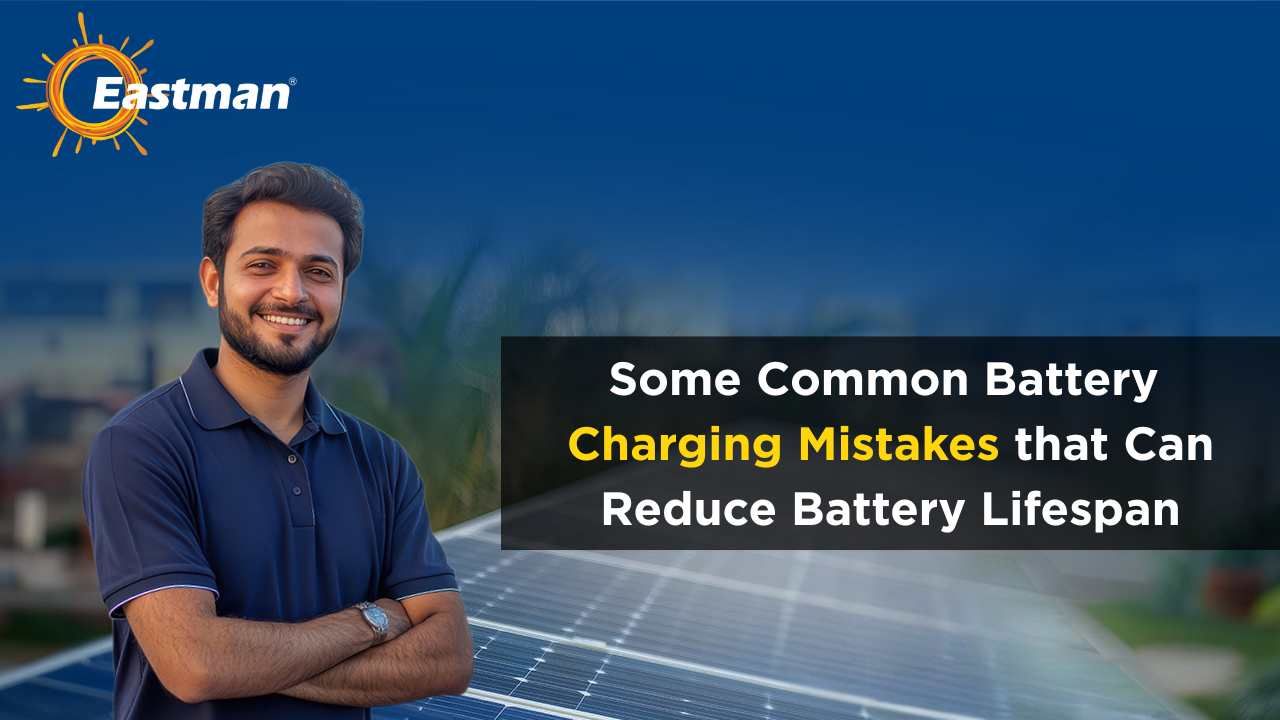
Some Common Battery Charging Mistakes that can Reduce Battery Lifespan
In today’s power-driven world, whether you rely on solar batteries, inverter batteries, lead-acid batteries, or lithium-ion batteries, maximizing battery lifespan is crucial. Even the best batteries can fail early due to simple, avoidable battery charging mistakes.
In a world powered by renewable energy and smart devices, battery performance has become the backbone of reliability. Yet, many batteries fail long before their expected lifespan, not because of manufacturing defects, but because of avoidable charging habits. Understanding these mistakes is the first step toward ensuring your system stays efficient, dependable, and long-lasting.
This guide highlights the most common battery charging mistakes, why they shorten battery lifespan, and offers the correct practices to ensure reliable energy storage solutions to get the most out of your investment. Whether you run a home inverter or a rooftop solar setup, these tips matter.
Why Battery Charging Matters: The Foundation of Longevity
Battery charging isn’t just a routine task; it’s one of the most critical factors that determines battery lifespan, performance, and long-term reliability. Battery degradation is an inevitable process; every battery, whether used in solar systems, inverter backups, or daily electronics, relies on proper charging to maintain its internal chemistry and efficiency. The adequate charging habits help:
- Prevent early battery ageing
- Maintain consistent power output
- Improve energy efficiency
- Reduce long-term maintenance costs
- Extend the overall lifespan of the battery
Improper charging practices accelerate chemical reactions within the battery, leading to: Reduced runtime, increased internal resistance, Premature cell failure, Safety hazards and thermal issues, & Costly, unexpected replacements. This silently damages the battery.
Understanding why battery charging matters is the foundation for avoiding common mistakes and adopting safer, more innovative practices that maximize battery performance.
The 6 Most Critical Battery Charging Mistakes
1. Overcharging and Letting Batteries Stay at 100% Continuously
One of the most widespread mistakes is treating your battery like a smartphone, charging it to full capacity every time. While this might seem logical, it's one of the fastest ways to degrade your battery. Keeping a battery topped at 100% for extended periods stresses the internal cells. This is particularly harmful for lithium-ion batteries, where repeated full charges accelerate capacity degradation.
Why it’s dangerous:
- In lead-acid batteries, it causes electrolyte loss, corrosion, and sulfation.
- In lithium-ion batteries, it increases internal pressure and accelerates degradation.
- In solar battery systems, faulty charge controllers can cause prolonged periods of overcharge.
Use smart chargers or a reliable solar charge controller to prevent this. For solar- or inverter-connected lead-acid batteries, overcharging can cause internal heating, electrolyte loss, or sulphation, all of which shorten lifespan.
2. Deep-Discharging Battery Frequently
While charging to 100% is harmful, discharging too deeply is equally damaging. Consistently draining your battery below manufacturer-recommended levels causes permanent damage to internal components. Allowing a battery to discharge fully, especially in lithium-ion packs, is another common error. Deep discharges amplify electrochemical stress and reduce cycle life.
Deep discharge battery damage leads to:
- Lower capacity
- Reduced performance
- Shortened cycle life
- Unstable voltage output
To extend battery life, keep your State of Charge between 20% to 80%. In solar setups, consistently draining the battery too low without timely recharge may lead to a performance drop or an inability to hold a charge properly.
3. Ignoring Temperature and Environmental Conditions During Charging
Battery charging is sensitive to temperature and environmental conditions. Charging in extreme heat or cold, or in poorly ventilated areas, can cause irreversible damage, and battery lifespan can be reduced by up to 50%. For instance, lithium-ion batteries require controlled temperature and proper charging current to avoid degradation.
Extreme temperatures cause:
- Thermal runaway in lithium-ion batteries
- Plate corrosion in lead-acid batteries
- Reduced charging efficiency in solar batteries
- Premature battery failure
Install your battery system in a climate-controlled environment. Maintain operating temperatures between 15 and 25°C. Always charge in a cool, ventilated area, maintain proper ventilation and avoid direct sunlight. Indoor installation in temperature-controlled spaces can extend lifespan by 3-5 years compared to outdoor installations in hot climates.
4. Skipping Regular Maintenance: Terminals, Fluid Levels, Connections
For lead-acid batteries standard in inverters/UPS and solar backup systems, neglecting maintenance like checking electrolyte levels, cleaning corroded terminals, and inspecting connections significantly reduces battery efficiency and lifespan.
Battery maintenance checklist:
- Clean terminals
- Check connections
- Ensure proper ventilation
- Maintain correct electrolyte levels
- Inspect cables for wear
This simple routine helps prevent common battery problems and significantly improves battery performance. Check electrolyte levels monthly every 2-3 weeks in hot climates. Use only distilled water. Fill cells to just above the lead plates, typically to the designated fill line. Loose or corroded connections also cause poor charging performance, sometimes masking deeper battery issues until it's too late.
5. Overcharging and Allowing Continuous Float Charging
Overcharging occurs when a battery is charged beyond its maximum voltage capacity. While modern systems have safeguards, improper charger settings or faulty BMS can still cause this critical issue.
Overcharging consequences:
- Excessive electrolyte gassing and water loss
- Grid corrosion in lead-acid batteries
- Internal short circuits
- Thermal runaway in lithium-ion systems
Use a smart charger with automatic cutoff capabilities. Modern home inverters and BMS systems include automatic disconnect features that stop charging once the battery reaches full capacity. For lead-acid batteries, implement periodic equalization charges under controlled conditions to remove sulphate crystals and balance cell voltage.
6. Treating All Batteries the Same Regardless of Type
Connecting aged batteries with new ones creates a dangerous imbalance. The older battery's higher internal resistance causes it to charge and discharge at different rates, leading to overcharging of new cells and undercharging of old ones. Not all batteries are built the same; lead-acid, lithium-ion, and nickel-based batteries all have distinct charging profiles and care requirements. Every battery chemistry has different charging needs:
- Lithium-ion battery charging requires precise voltage control
- Lead-acid battery charging needs staged charging
- Solar batteries depend heavily on charge controller quality
Following a one-size-fits-all approach is a guaranteed way to reduce your battery lifespan. Always replace batteries in complete matched sets. Never combine batteries of different ages, brands, or chemistries in a single system. When upgrading, replace the entire bank to ensure uniform performance and longevity.
Best Practices to Extend Your Battery’s Life
- Maintain optimal charge levels, avoid extremes: Instead of charging to 100% or draining to 0%, aim to keep battery state-of-charge (SoC) in a moderate range. Research suggests that maintaining a SoC range of 20%–80% reduces stress and significantly extends cycle life.
- Charge in a proper temperature and ventilated environment: Keep batteries away from extreme heat or cold; ensure ambient temperature and ventilation are conducive to safe charging.
- Regular maintenance for lead-acid/solar batteries: Check electrolyte levels (if applicable), clean and tighten terminals, inspect wires and connections, and ensure proper ventilation.
- Use innovative charging / battery-management systems when possible: Smart chargers or charge controllers help regulate voltage/current, prevent overcharging, and optimize battery health over the long run.
- Avoid a one-size-fits-all approach, adapt to specific battery chemistry: Understand whether your system uses lead-acid, lithium-ion or solar-storage batteries, and follow corresponding best practices.
Why Choose Eastman: Commitment to Battery Quality
At Eastman Auto & Power Ltd, we don’t just manufacture batteries; we engineer them with care, longevity, and real-world performance in mind. Here’s how we stand out:
- Wide range of battery chemistries: From dependable lead-acid batteries for inverters and UPS, to advanced lithium-ion packs for EVs and solar storage.
- Smart design & power electronics integration: Our manufacturing infrastructure ensures that battery, power electronics, and charge controllers are optimally matched for efficiency and safety.
- End-to-end solar solutions: With our rooftop solar, energy-storage, and inverter offerings, we deliver holistic solutions that maximize ROI and battery life.
- Customer education & support: We believe an informed user gets more from their system, which is why we share best practices like these to help you get the most out of your battery investment.
Conclusion
Your battery is more than just a box of stored energy; it’s a long-term investment. But improper charging habits, neglect, or misuse can silently chip away at its lifespan. By avoiding common mistakes, like overcharging, deep discharging, using the wrong chargers, or skipping maintenance and adopting intelligent charging practices, you ensure your battery performs reliably for years to come.
At Eastman, we are committed to building not just batteries, but trust, helping you power your life efficiently, sustainably, and for the long haul.
Ready to invest in Solar Solutions?
Discover the full range of Lead-Acid Batteries, Lithium-Ion Battery Packs, Solar Storage & Rooftop Solar Solutions. Eastman helps you choose the right battery system and guides you with optimal charging & maintenance practices for decades of reliable power.
Get your estimate on On‑Grid Solar Combos & Calculator
Contact EAPL for more information.
Please use our Store Locator to find your nearest store.
FAQ’s
Q. Is it dreadful to charge my battery to 100% before unplugging?
A: Frequently charging to 100% and keeping it topped up increases stress on battery cells, especially for lithium-ion. To maximize battery lifespan, it’s better to maintain a partial charge (e.g. 20%–80% SoC) rather than complete cycles.
Q: Can overcharging a lead-acid solar battery cause a hazard?
A: Yes. Overcharging lead-acid batteries can lead to excessive heat, electrolyte loss, corrosion or sulphation; all of which degrade performance and shorten usable life.
Q: Does using a fast charger damage the lithium-ion battery faster?
A: Yes, possibly; if the charger isn’t compatible or doesn’t regulate voltage/current properly. Fast charging that ignores safe charging protocol can accelerate degradation.
Q: How often should I check and maintain my solar/inverter battery?
A: As a good practice, inspect terminals, connections, and electrolyte levels at least once a month. Also, ensure the battery area is clean, ventilated, and free from dust or moisture.
Q: Are all batteries in my home the same when it comes to charging?
A: No. Batteries differ by chemistry: lead-acid, lithium-ion, solar-storage, etc. Each type has unique charging and maintenance requirements. Treat them accordingly for optimal performance.
Keywords:
Mistakes, battery lifespan, solar maintenance, inverter battery care, avoid battery overcharging, Checklist, solar inverter battery guide, battery problems, safe practices, top solar battery brands, best battery brands in India, reliable battery manufacturers, trusted solar battery brand, energy storage solutions, Renewable energy, Sustainable Energy.


 78728 78728